The Sales Landscape Has Changed — Have Your Teams?
The average B2B buyer today completes 60–70% of their decision-making journey before they ever speak to a salesperson. They have already read the reviews, studied the competitors, and formed a view. By the time they reach your team, they are not looking for information they are looking for confidence, clarity, and credibility.
This shift has profound implications. Sales teams that rely purely on product knowledge and persuasion tactics are becoming less effective. The professionals who win today are those who understand the buyer deeply, communicate value compellingly, and build relationships that outlast the initial transaction.
In short, selling in 2026 demands a different kind of professional and a different kind of team.
1. They Sell With Brand, Not Just Product
The most consistent characteristic of high-performance sales teams is that they sell with brand. They understand that every interaction carries the weight of the company's reputation, values, and promise — and they act accordingly.
Brand-led selling is not about logos or taglines. It is about how your team shows up in a conversation. It is the confidence they project, the story they tell, the standards they maintain, and the trust they earn at every touchpoint.
Visibility gets you noticed. Credibility gets you trusted. Influence gets you chosen.
High-performing sales professionals understand this sequence. They invest in being known for something specific, building credibility through expertise and consistency, and exercising influence that moves clients towards confident decisions not just quick ones.
Organisations that invest in building a branded sales culture see higher conversion rates, stronger client retention, and a more resilient team identity when markets get tough.
2. They Are Led by Coaches, Not Just Managers
The most significant driver of sales team performance is not the incentive structure — it is the quality of sales leadership.
Managers tell. Coaches develop. In 2026, high-performance sales teams are almost always led by leaders who have made the shift from managing activity to developing capability.
A coaching-led sales culture looks like this:
Regular one-to-one conversations focused on growth, not just pipeline review
Leaders who ask powerful questions rather than provide all the answers
A shared commitment to learning from both wins and losses
Psychological safety that encourages team members to flag challenges early
The research is clear: sales teams with effective coaching leadership consistently outperform those managed purely through KPIs and targets. Sales leadership is not just a functional role it is a strategic differentiator.
3. They Use AI as a Competitive Advantage
AI has entered the sales floor and teams that use it strategically are gaining a measurable edge.
High-performance sales teams in 2026 are not waiting to be told how to use AI. They are already using it to research prospects with greater depth, personalise outreach at scale, analyse pipeline data in real time, and identify the signals that distinguish a buyer who is ready to move from one who needs more nurturing.
AI will not replace human expertise. But professionals who know how to use AI will consistently outperform those who do not.
The critical distinction is this: AI handles volume and pattern recognition. Human professionals handle nuance, judgement, and relationship. The winning combination is both applied intelligently.
Sales organisations that are building AI literacy into their team training programmes are not just improving efficiency. They are building a competitive capability that compounds over time.
4. They Operate With a Clear Sales Framework
Inconsistency is one of the most common and costly problems in sales organisations. When each team member operates with a different approach, results become unpredictable and coaching becomes nearly impossible.
High-performance sales teams follow a clear, shared framework that gives structure to every stage of the client journey without making it feel scripted or transactional.
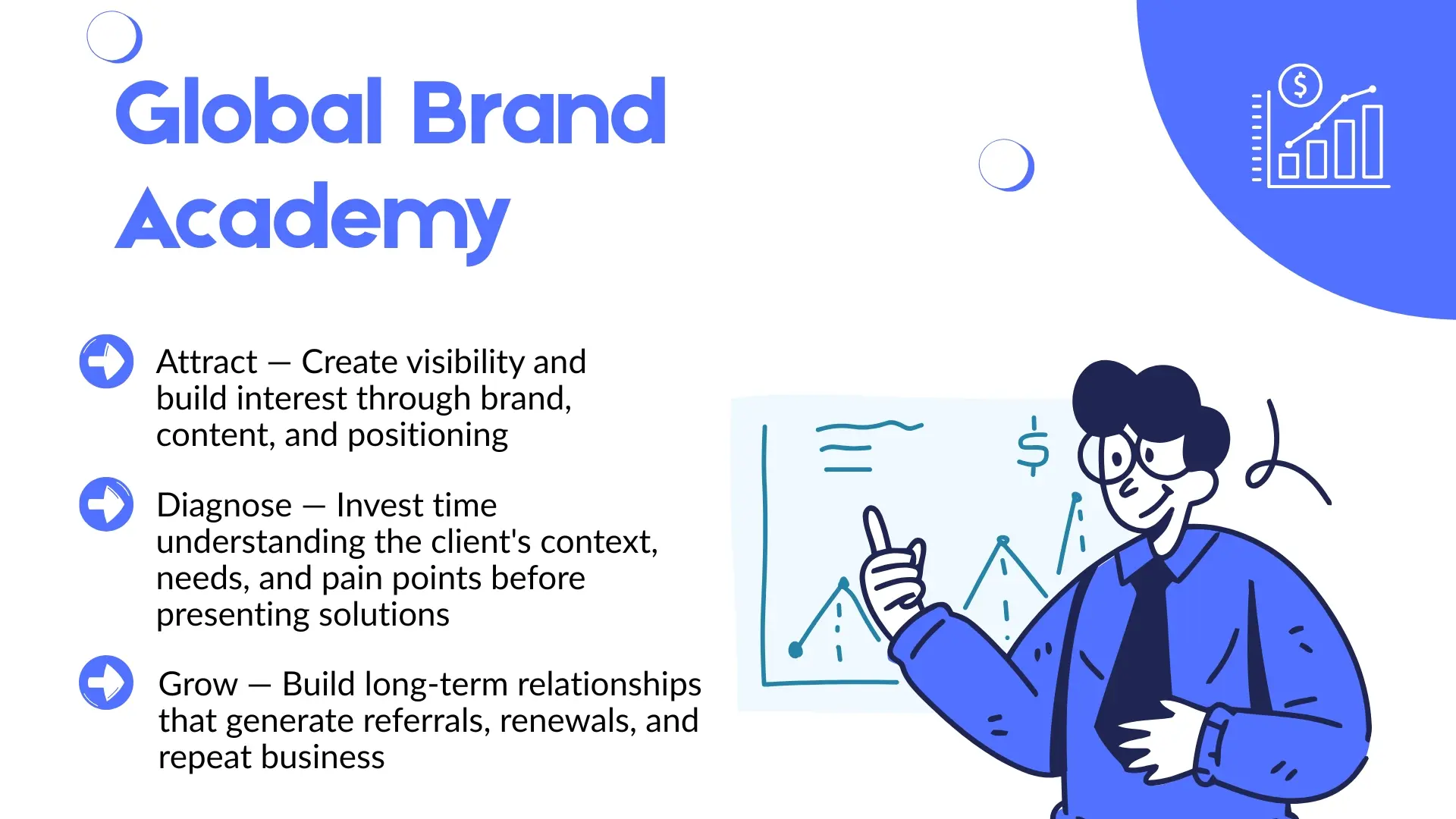
The Future of Selling Framework used by the Global Brand Academy identifies five critical stages:
Attract — Create visibility and build interest through brand, content, and positioning
Diagnose — Invest time understanding the client's context, needs, and pain points before presenting solutions
Influence — Communicate value clearly, address concerns, and shape the client's thinking
Commit — Move the client towards a confident decision with clarity and conviction
Grow — Build long-term relationships that generate referrals, renewals, and repeat business
When the entire team speaks the same language, follows the same structure, and reinforces the same standards, performance becomes both more consistent and more coachable.
5. They Have a Culture of Continuous Learning
Markets evolve. Buyers change. Tools improve. The sales teams that maintain high performance over the long term are the ones that treat learning as a competitive strategy, not an annual event.
High-performance sales teams invest in ongoing development not just a once-a-year training day. They regularly revisit fundamentals, sharpen communication skills, study their competition, and explore new methodologies.
This is where the role of structured sales training becomes critical. A well-designed sales training programme does not just improve technique. It builds a shared mindset, reinforces a common standard, and creates a team culture where growth is expected rather than occasional.
Organisations that treat sales training as a cost tend to see it as a disruption. Organisations that treat it as a capability investment consistently see returns in pipeline quality, conversion rates, and team retention.
6. They Prioritise Customer Experience, Not Just the Close
The best sales professionals understand something that average ones miss: the sale is not the destination. It is the beginning of the relationship.
High-performance teams in 2026 are not optimised purely for the close. They are optimised for the entire customer experience before, during, and after the sale. They understand that a client who feels well-served during the sales process is far more likely to buy again, refer others, and expand the relationship over time.
This requires a mindset shift from transactional to relational. It means thinking about what the client needs, not just what you are trying to sell. It means being willing to slow down the conversation when a client is not ready rather than pushing for a close that will not hold.
Culture becomes customer experience. When a sales team operates with genuine care for the clients they serve, that care shows up in every interaction and clients notice.
7. They Measure What Actually Matters
High-performance sales teams track more than revenue. Revenue is a lagging indicator it tells you what already happened. The metrics that drive performance are the ones that tell you what is about to happen.
The most effective sales organisations in 2026 monitor:
Pipeline quality and velocity — How strong is the pipeline? How quickly are opportunities moving?
Conversion rates by stage — Where are deals being lost? What patterns emerge?
Average deal size and sales cycle length — Are these trending in the right direction?
Client retention and expansion — Are existing clients growing with you?
Net Promoter Score (NPS) among new clients — Did the sales experience create advocates?
When teams measure what matters, they can diagnose problems early, double down on what works, and make informed decisions about where to focus coaching and development effort.
The Role of Sales Training in Building High-Performance Teams
Building a high-performance sales team does not happen by accident. It requires intentional investment in people, process, and culture and that investment needs to be led with strategic intent.
At the Global Brand Academy, sales training programmes are designed around a simple but powerful principle: the best salespeople are brand ambassadors, trusted advisors, and skilled communicators not just product experts.
Led by Dr Jerome Joseph ranked No. 2 Global Brand Thought Leader in the World and a Certified Speaking Professional with 30 years of experience working with over 1,000 brands across 40 countries the Academy's sales programmes equip teams with the frameworks, mindset, and skills to sell with brand confidence, build lasting client relationships, and perform consistently in a complex, fast-moving marketplace.
Whether your team needs to sharpen fundamentals, navigate AI-enabled selling, or build a unified sales culture, the Global Brand Academy delivers transformational outcomes not just training sessions.
Frequently Asked Questions
What defines a high-performance sales team?
A high-performance sales team consistently meets and exceeds commercial targets while maintaining strong client relationships, operating with a shared methodology, and building a culture of continuous development. In 2026, the most effective teams combine brand-led selling, coaching leadership, AI capability, and a focus on customer experience not just the close.
How can sales leaders improve team performance in 2026?
Sales leaders can improve performance by shifting from managing activity to developing capability. This means regular coaching conversations, investing in structured sales training, introducing a clear sales framework, and building psychological safety that encourages honest conversations about challenges. AI literacy is also increasingly important leaders who model good AI habits accelerate team adoption.
What is brand-led selling?
Brand-led selling is an approach where sales professionals represent not just their product or service but the entire brand its values, standards, and promise. It shifts the focus from transaction to trust, from features to value, and from one-off sales to long-term relationships. Organisations that train their sales teams to sell with brand consistently achieve higher conversion rates and stronger client retention.
How does AI impact sales teams in 2026?
AI is transforming sales by enabling faster prospect research, personalised outreach at scale, real-time pipeline analysis, and smarter forecasting. High-performance sales teams use AI to handle volume tasks and pattern recognition, freeing their professionals to focus on the relationship, judgement, and creative problem-solving that AI cannot replicate. The competitive advantage belongs to teams that use AI intentionally, not reactively.
What sales training does the Global Brand Academy offer?
The Global Brand Academy delivers sales training programmes, workshops, and masterclasses designed for corporate teams, sales leaders, and individual professionals. Programmes cover brand-led selling, the Future of Selling Framework, AI in sales, customer experience, and sales leadership all tailored to the specific context and goals of the organisation. Learn more at theglobalbrandacademy.com.
How long does it take to build a high-performance sales team?
Building a high-performance sales team is a continuous process, not a one-time event. Organisations that commit to structured development over 6–12 months combining sales training, consistent coaching, performance measurement, and cultural reinforcement see the most significant and sustainable improvements. Quick fixes rarely produce lasting results.
The Takeaway
High performance in sales is not a product of pressure. It is a product of strategy.
The organisations pulling ahead in 2026 are those that have made deliberate investments in their people, their processes, and their culture. They have equipped their teams with clear frameworks, strong leadership, AI capability, and the brand confidence to show up as trusted advisors not just vendors.
If your sales team is working hard but not achieving the results the business needs, the answer is rarely more pressure. It is better development, stronger leadership, and a more strategic approach to selling.
The strongest brands do not chase attention. They build association. The strongest sales teams do not chase transactions. They build trust.
Ready to Build a High-Performance Sales Team?
The Global Brand Academy works with organisations across the world to transform sales culture, elevate team performance, and build the capability needed to thrive in a complex, AI-enabled marketplace.
Explore our sales training programmes and masterclasses at theglobalbrandacademy.com — or reach out directly to discuss a tailored programme for your organisation.